Cross-Border Ultrasound Probe Repair: A Verification File
Same symptom on your system?
Tell us your model and what it is doing. A GEPROBE engineer replies with a diagnosis path, part options and pricing — usually within 6 hours, with no obligation.
Chat on WhatsApp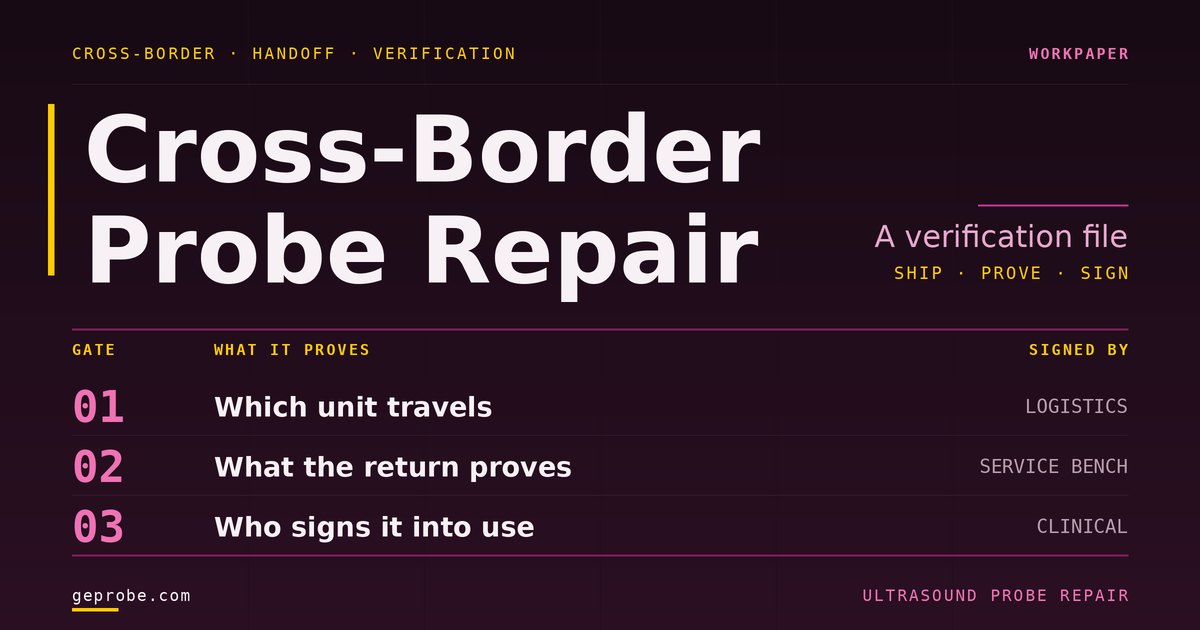
Cross-border ultrasound probe repair is usually planned as a shipping event. It is better planned as three decisions, because each one needs a different piece of paper.
Which unit leaves the building. What the return has to prove. Who signs it back into patient use.
Get those three out of order and the paperwork multiplies while the probe stays in a box.
Operational guidance only, not customs or regulatory advice. Every rate in the worked example is illustrative and belongs to your site, not to ours.
Decide which unit travels before you describe the fault
Most sites write the fault description first and choose the shipment second. Reverse it.
A bench can only test what it can reproduce. The scope you ship decides whether your symptom is testable at all, so the scope is the first decision and the fault write-up is the second.
| What you ship | What the bench can actually test | Choose it when |
|---|---|---|
| The probe alone | The probe on the bench's own host and software | The fault follows the probe across two ports on your console |
| The probe with its console | The fault in your configuration, your revision | The console only fails with that probe and no spare host exists |
| A stock part, nothing shipped | Nothing. You are replacing, not diagnosing | A hard failure you can pin to one part number |
| An evaluation, no repair yet | Whether the fault reproduces at all | The symptom is intermittent and you have not localised it |
Ask for the repair price and the replacement price on the same line item. GEPROBE's published process quotes repair-or-replace options against a free evaluation (geprobe.com/repair) — reviewed 2026-11-20.
A quote that offers only one of the two hides the decision you are actually making.
Price the round trip, including the days nobody bills for
For cross-border ultrasound probe repair, the cheapest quote is rarely the cheapest option. Put the downtime in the same sum as the invoice:
downtime_adjusted_cost =
    repair_quote
  + freight_out + freight_back + clearance_fees
  + (transit_out + bench + transit_back + clearance_days) * cost_per_clinical_day
  + loaner_days * loaner_rate
Run that for every scope in the table above. The one with the smallest invoice often loses on the second line.
Then test the gap between two quotes directly:
break_even_extra_days = quote_gap / cost_per_clinical_dayIf one option is 900 cheaper but 4 days slower, and a clinical day costs 300, the slower option is 300 worse overall. At 3 days slower the two are level, and only below that does the cheaper quote win.
The number that decides this is cost_per_clinical_day: cancelled slots, exams rebooked to a partner site, or a rented unit's day rate. No supplier can fill that in for you, which is why the comparison so often goes unbuilt.
Separate the clocks when you approve anything. GEPROBE publishes a free 24-hour evaluation with a failure report, then quote, repair, and QA before return (geprobe.com/repair) — reviewed 2026-11-20.
That is an evaluation clock. It says nothing about bench days or transit, and a quote that merges the three cannot be scheduled against.
Ask whether freight is door-to-door. GEPROBE's site states prepaid shipping both ways with protective packaging (geprobe.com) — reviewed 2026-11-20. A quote that excludes inbound freight is a different number.
One probe and no reference unit: the verification ladder
This is where most small sites fall over on cross-border ultrasound probe repair. One probe per port, no spare, no second console to cross-check against.
The usual answer is "describe what you could not test". That produces a report nobody can act on. Build a ladder instead, weakest evidence at the top.
- Before you ship, save a baseline. If the probe images at all, capture one frame per preset on a tissue-equivalent phantom and export it as DICOM.
- Record the port map. Move the probe to a second port on the same console and note whether the symptom follows the probe or the port.
- On return, compare against that archived frame. Same preset, same phantom, same depth and gain. Not against "it looks fine now".
- If no baseline exists, say so in the release record. A pass with no pre-repair baseline supports "works on arrival", not "restored".
- Demand a bench record naming your host. GEPROBE's capability list includes connector pin work, EEPROM reprogramming and compatibility verification on host systems (geprobe.com/repair) — reviewed 2026-11-20.
Step five is the one worth arguing about. A test report that does not name the host model and software revision it ran on describes the bench, not your unit.
Extra diligence is cheap here: GEPROBE states that returns include a test report and cosmetic checklist (geprobe.com) — reviewed 2026-11-20. Read it against your own serial number before you sign.
Send this before you ask for a price
Every missing field becomes a question on day three, and every question round is a transit day you did not budget. Send all of it at once:
Probe:  model, serial from the label, part number
Host:   model, software revision, which port
Symptom: preset, probe position, when it starts, what it looks like
Scope:  does the fault follow the probe to a second port?
Ruled out: cables, port, probe, anything else you swapped
Photos: label, connector, lens or bending rubber, one frame of the fault
Quote:  repair price, replacement price, door-to-door freight, warranty term
GEPROBE's published intake is a model, serial number or photo, and the contact page states a reply within one working day (geprobe.com/contact) — reviewed 2026-11-20.
Seven fields, one message. That is the whole template, and it converts a week of clarification into a single reply.
The release chain: five signatures, in order
An acceptance that lives in one person's head is not an acceptance. Split it, and make each signature assert something narrow.
- Receiving: identity, seal, visible condition and connector state, recorded by whoever opened the box
- Configuration: part number and revision match the work order, and the host recognises the probe
- Performance: imaging comparison against the archived baseline, or a phantom result with the missing-baseline caveat
- Electrical: the site's after-repair safety test, with recorded values and the method named
- Clinical: the named owner releases the probe for patient use, with infection-control clearance recorded
The first signature is the one that gets confused with the last. Whoever signs the courier's device is confirming that a box arrived. That is all it confirms.
Electrical evidence deserves its own warning.
IEC 62353:2014 covers recurrent testing and testing after repair. Its own scope says it does not define requirements for repair, component exchange or modification (webstore.iec.ch/en/publication/6913) — reviewed 2026-11-20.
So a passing safety test is evidence about safety. It is not evidence that the probe was repaired, and it should never close the performance line on its own.
When the returned unit fails your acceptance
Two different failures get called "failed repair", and they need opposite responses.
"Not repaired" means the fault is back. "Not verified" means the evidence is missing but the probe may be fine. Sending a unit back for rework when the gap is a test report spends a round trip to buy an email.
| Failure class | Who owns the evidence | Default position | Ship again? |
|---|---|---|---|
| Same symptom, same conditions | The bench | Rework under the stated warranty | Yes, once, with the failing record attached |
| Same symptom, only on your console | Your site first | Neither side has shown the other wrong | No. Characterise the difference first |
| New symptom, packaging intact | The bench | Treat as a new fault until the record says otherwise | Only inside the work-order scope |
| Crushed box or breached seal | Freight, not the bench | Claim, with opening photos | Yes, after the claim is logged |
| Wrong revision or a substitute unit | Identity | This is a substitution, not a repair | No. Settle identity and entry first |
| Electrical pass, imaging fail | Nobody yet | A test-scope gap | No. Ask for the missing test |
Note the fifth row. A substitute that arrives instead of your probe leaves the customs question and the acceptance question both open, and they close separately.
A substitute also raises a regulatory question that has nothing to do with freight.
FDA's May 2024 guidance exists to separate servicing from remanufacturing, because the second carries manufacturer responsibilities (FDA guidance, docket FDA-2018-N-3741) — reviewed 2026-11-20.
Ask for the warranty term in writing before you ship, not after the first failure. GEPROBE's site states coverage on repairs and replacement parts (geprobe.com) — reviewed 2026-11-20.
Keep the customs file to three fields
Almost every broker question reduces to: what left, what came back, what changed between the two. Build the file around those three and most of the correspondence disappears.
In the United States the relevant provision is titled "Articles exported for repairs or alterations" (19 CFR 10.8, GovInfo) — reviewed 2026-11-20.
Its usefulness depends on being able to argue the returning item is the exported one, which is a serial number and a labelled photograph, not a paragraph.
For the European Union, outward processing sits in Regulation (EU) No 952/2013 (EUR-Lex, CELEX 32013R0952) — reviewed 2026-11-20.
The authorization must match the re-import; a generic authorisation for a similar assembly is not the same thing.
A note on what we did not verify, because this is the section where writers invent clauses.
We read the regulation page but did not verify the article-level discharge conditions, so treat those as broker-confirmed rather than as stated here.
Bonded-zone repair routes for named products also exist outside the US and EU, and their eligibility turns on the specific product, its condition and the receiving operator's approved activity.
We did not verify the current catalogue numbering for this review. Assume it is enclosed-list-specific until someone shows you the line.
If a substitute rather than your own unit is returning, stop. Two decisions are open, and customs will not be the one that closes last.
Six months later: hand the file to a stranger
Give the folder to a colleague who did not run the repair and ask four questions. Which unit left. What changed on it. What the return test actually covered. Who signed it back into use.
If they cannot answer from the folder alone, the repair was not the problem. The file is.
That test is worth more than a thick binder, because it measures the only thing the next auditor will care about: whether the record can be replayed without you in the room.
Start with the parts catalogue when the fault is a hard failure rather than an intermittent one (ultrasound parts). When it is intermittent, start with a repair evaluation and the intake message above.
Sources
- GEPROBE repair services: process, capabilities, parts repair — reviewed 2026-11-20.
- GEPROBE: repair process, documents, warranty and shipping terms — reviewed 2026-11-20.
- GEPROBE contact page: intake and stated reply window — reviewed 2026-11-20.
- GEPROBE ultrasound parts catalogue — reviewed 2026-11-20.
- 19 CFR 10.8, Articles exported for repairs or alterations (GovInfo, CFR 2024 ed.) — reviewed 2026-11-20.
- IEC 62353:2014, recurrent test and test after repair (scope statement) — reviewed 2026-11-20.
- Regulation (EU) No 952/2013, Union Customs Code (EUR-Lex) — reviewed 2026-11-20. Article-level discharge conditions not verified.
- FDA, Remanufacturing of Medical Devices, final guidance May 2024 (docket FDA-2018-N-3741) — reviewed 2026-11-20. Cited for the servicing-versus-remanufacturing boundary only.
Related Articles
3D Ultrasound Export: Volume, Cine, or Probe Record
A 3D ultrasound export judged by byte arithmetic, plane spacing and destination pairing — and what the volume proves about the probe.
Ultrasound QA Baseline Drift: Triage Before You Repair
Ultrasound QA baseline drift, worked in order: a measured noise floor, a one-session swap design, a cost threshold, and what a clean image cannot prove.
Qualifying a Refurbished Ultrasound Parts Supplier
Sample size, landed cost, response clocks and a repair ceiling: the arithmetic to run before a refurbished ultrasound parts trial order.