Qualifying a Refurbished Ultrasound Parts Supplier
Same symptom on your system?
Tell us your model and what it is doing. A GEPROBE engineer replies with a diagnosis path, part options and pricing — usually within 6 hours, with no obligation.
Chat on WhatsApp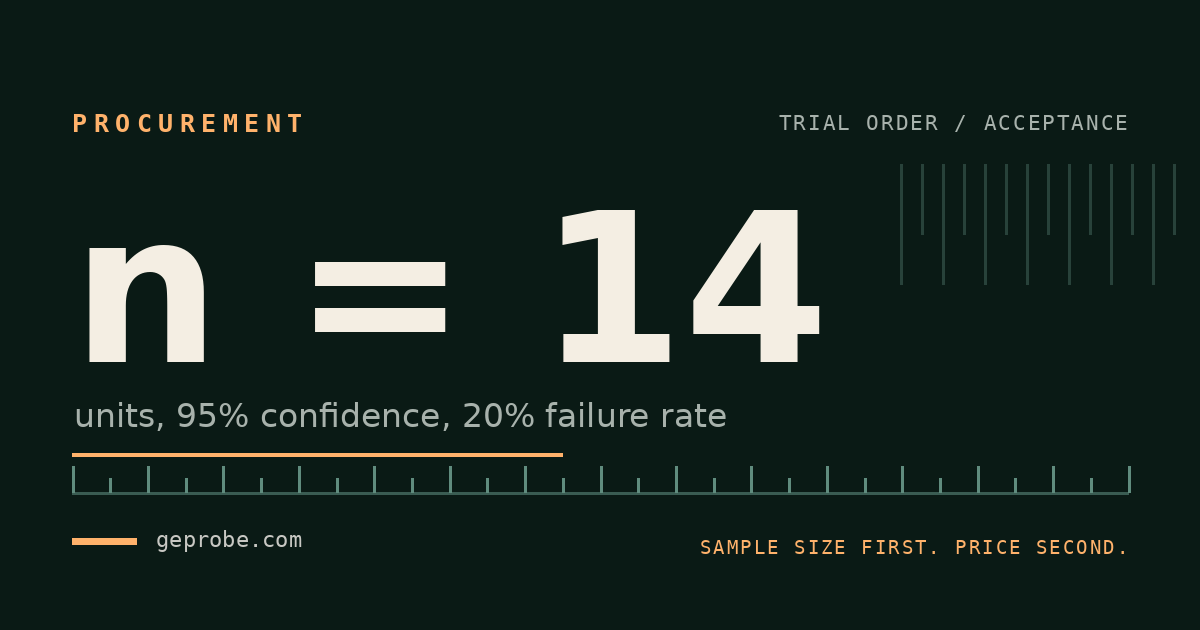
Qualifying a refurbished ultrasound parts supplier with one small purchase is usually run as a paperwork exercise with a box attached.
It is really three numbers and one clock, and most buyers never choose any of them on purpose.
How many units to buy. What each costs on the dock. Whether a failed unit is worth repairing. How long the supplier takes to answer.
Settle those before you request a quote.
Commercial and operational guidance only. Not legal, tax or customs advice. Every figure below marked illustrative is a placeholder for your own quote.
The unit count is a sampling decision, and it is usually too small
A trial order is acceptance sampling with zero failures tolerated. That framing gives you a defensible quantity instead of a round number.
The arithmetic is binomial and fits in one spreadsheet cell:
n = ln(1 - C) / ln(1 - p)
Here C is the confidence you want that a bad unit would have been caught, and p is the failure rate you are unwilling to accept.
Set C at 0.95 and p at 0.20 and you get 13.4, so 14 units.
Set p at 0.30 and the answer is 9.
The uncomfortable part is what a clean small pilot actually proves.
Three units that pass every check are still consistent with a defect rate near 63% at 95% confidence, because the upper bound is 1 − 0.05^(1/3).
That is the rule-of-three effect in blunt form. Buyers quote the passing result and skip the bracket.
| Units bought | Zero failures implies (95% upper bound) | What the pilot can support | Where it is the wrong buy |
|---|---|---|---|
| 1 | 95% | That the item exists, ships and powers on | Any statement about consistency |
| 3 | 63% | Packaging discipline, revision match, one bench result per line | A claim that the supplier is reliable |
| 5 | 45% | The same, plus a first look at handling variance | Anything about a 5% failure rate |
| 14 | 19% | A defensible statement that 20% defects would have shown | A small-spend replenishment decision |
| 30 | 9.5% | A screening standard you can hold a supplier to | A first order from an unproven source |
Two rules follow. Buy the quantity your risk tolerance supports, not the quantity the storeroom wants, and write the acceptance criterion before you know the price.
Once supply is running, move to lot-by-lot plans rather than repeating accept-on-zero.
ISO 2859-1:2026 covers AQL-indexed sampling schemes for continuing lots, including skip-lot procedures (reviewed 2026-11-14).
It assumes a series of lots from one process. A single delivery is not that series.
Land the cost before you compare prices
Two quotes for the same board are not comparable if one is Ex Works and the other is delivered duty paid.
The ICC Incoterms 2020 rules allocate cost, risk and clearance obligations between the parties (reviewed 2026-11-14).
The rule on the quote decides how much of the landed total is already inside the price you are comparing.
The landed figure you want is one line per component. The duty term depends on the customs value, which depends on the Incoterm:
landed = goods + freight + insurance + duty + brokerage + inbound handling + currency cost + (return freight reserve / n)
| Cost component | Ex Works quote | FOB quote | DDP quote |
|---|---|---|---|
| Goods value | In the price | In the price | In the price |
| Export clearance | Yours to arrange | Seller's side | Seller's side |
| Main freight and insurance | Yours | Yours | In the price |
| Import duty and tax | Yours, on the declared value | Yours, on the declared value | In the price, check the declared value |
| Brokerage and entry fees | Yours | Yours | In the price |
| Damage claim in transit | Yours against the carrier | Yours against the carrier | Seller's to file, yours to evidence |
| Currency and payment cost | Yours | Yours | Yours |
A worked example, all inputs illustrative: 1,850 goods, 210 freight, 109 insurance, 4% duty on goods and freight, 145 brokerage, 60 inbound handling, 25 currency cost.
That lands at 2,481, which is 34% above the unit price.
The duty rate is the one input no article can give you. Ask your broker for the classification and rate on the exact part.
The bigger number is usually the pilot's own cost, and it does not appear on any invoice from the supplier.
Receiving labour, bench occupancy, engineering review and a returns reserve come to roughly the price of a whole probe.
Put that total over the unit count and the arithmetic changes character: about 620 per unit at three units, about 133 per unit at fourteen.
That is the argument for a defensible quantity: qualification cost per unit falls faster than goods cost rises.
Measure response time on five questions, before the order
Every buyer eventually says the supplier went quiet after the money moved. Almost nobody measures quiet beforehand.
Send five questions before you place the order, and timestamp three separate clocks on each one.
- Clock one: first human acknowledgement, with automated replies excluded.
- Clock two: the first answer containing a technical fact you can verify.
- Clock three: the point where the question is closed without you asking again.
Send them during the supplier's business hours, through the channel you will order through, and log timestamps as they happen.
Use the median, not the average, so one holiday does not rewrite the result.
Include one question with a false premise, such as a part number that does not exist for that platform. A supplier who corrects you is reading. A supplier who quotes it is pattern-matching.
The profile matters more than the raw numbers. Slow clock two with a fast clock three means someone is researching and then closing.
Fast clock two with a slow clock three is the profile that hurts: confident answers, no follow-through, and an RMA that stalls.
A measurement is not a commitment. Put the clock you need into the purchase order.
Decide repair or scrap with a ceiling, not a habit
When a trial unit fails, the reflex is to send it back for repair, because the quote looks small next to a new part.
The threshold is a ceiling on what a repair is worth attempting:
repair ceiling = landed - salvage value - re-test cost - risk premium
Using the landed figure above, with 15% salvage, a re-test charge and a 20% risk premium for another failure in service, the ceiling comes out near 1,391, or 56% of landed.
A repair quote above roughly half the landed cost of a replacement is a replacement.
| Trial outcome | Action | Freight | Evidence to keep |
|---|---|---|---|
| Fails on arrival, cause unclear | Quarantine, photograph, do not repair | Supplier, per PO | Carton photos, serial, measured values |
| Fails on bench, repair offered | Compare quote to the ceiling | Yours if repair accepted | Quote, before and after test values |
| Repair quote above the ceiling | Replace, hold the failed unit | Supplier, per PO | Credit note and RMA trail |
| Transit damage | Claim against carrier or insurer | Per the Incoterm | Survey report opened on arrival |
One rule overrides the table: do not scrap a failed unit until the credit is settled or the dispute is closed in writing.
The failed unit is the evidence. A scrapped unit turns a documented nonconformance into an opinion.
Keep a second source warm, and price that decision
Qualification cost is paid per supplier, not per part, which is why single-sourcing survives long past the point where it is cheap.
Qualifying a second source to the same standard costs another set of shipments at the rate above.
Set that number against your annual exposure on the part family: downtime, expedited freight, and the price a sole source can charge once your scanners depend on it.
If a single stockout on that family costs more than the qualification does, the second source is the cheaper line item.
Requalification is cheaper than qualification, and it has triggers worth writing down.
- A part number or revision change on an assembly you already approved.
- No orders for a year, so the approval is stale.
- Two consecutive late shipments, or one shipment whose documentation does not match the hardware.
- A firmware or configuration change the supplier did not tell you about.
A supplier that repairs as well as sells is easier to keep warm, because a repair order is a small continuous test of the same bench and the same paperwork.
Our own route runs that way: free evaluation, a flat-rate quote with a repair-or-replace option, restoration in a cleanroom, and imaging verification on host systems before return.
Each repair ships with a test report and a cosmetic checklist (GEPROBE repair services). Replacement assemblies are catalogued at /product/parts.
If you need the servicing-versus-remanufacturing question answered on paper, ask for it in the PO.
FDA's May 2024 guidance on remanufacturing describes how the two categories differ and carries a nonbinding-recommendations notice (FDA guidance, reviewed 2026-11-14). The supplier's written position belongs in your file.
Acceptance checklist for the trial shipment
Before the order goes out:
- The PO names model, part number, revision and firmware, with no substitution without written approval.
- The PO names the Incoterm, and who pays return freight on a rejection.
- The PO sets the acceptance window, and how much of the balance is held until acceptance.
- The PO lists the evidence that must travel with the unit: serial-linked test record, packaging record, and any decontamination statement.
On arrival:
- Photograph the carton before it is opened, all faces, with the waybill in frame.
- Compare the serial and revision against the PO and against the supplier's test record, not against the label alone.
- Record the receiving date and start the acceptance clock from it, in writing.
On the bench:
- Record measured values, not the word "pass", against the criterion fixed before the order.
- Test against a known-good reference, and note which reference was used.
- Keep the images, waveforms or logs for any failure before the unit leaves your building.
Before the balance is released:
- One sign-off, one file, one line per PO line item, with the reviewer named.
What the trial cannot tell you
A passing trial does not measure wear, latent handling damage, or how a supplier behaves when the order is fifty units and the deadline is short.
It measures the units you inspected, against the criterion you wrote, on the day you tested them.
That is still more than a questionnaire returns, provided the criterion existed before the price did.
Sources
- ISO 2859-1:2026, sampling procedures for inspection by attributes — reviewed 2026-11-14.
- ICC Incoterms 2020 rules — reviewed 2026-11-14.
- FDA, Remanufacturing of Medical Devices, guidance issued 2024-05-10 — reviewed 2026-11-14.
- GEPROBE repair services — reviewed 2026-11-14.
- GEPROBE ultrasound parts catalogue — reviewed 2026-11-14.
Related Articles
Ultrasound QA Baseline Drift: Triage Before You Repair
Ultrasound QA baseline drift, worked in order: a measured noise floor, a one-session swap design, a cost threshold, and what a clean image cannot prove.
Used Ultrasound Export UK: Prove Equipment, Not Waste
How to prove a used ultrasound is equipment rather than waste on a used ultrasound export UK shipment, with the probe-level evidence most files miss.
DICOM Photometric Interpretation vs. Color Doppler in PACS
Color Doppler that looks wrong in PACS is usually an encoding question, not a probe fault. A four-point check, a ship gate, and the arithmetic.